


"What Made You Cry?"

Updated: Apr 22
The untold stories at the Nashville City Cemetery.

As Tara Williams parks her black Hyundai Tucson in one of four parking spaces in the middle of the Nashville City Cemetery, she utters a phrase softly under her breath.
“Hi, friends. Thank you for what you did before to allow me to be here today.”
They’re not directed at anyone who can hear her, not even her colleague Jennifer Dougan, who steps out of the car simultaneously.
They’re for the over 20,000 people six feet below her.
“Those lives made today possible,” Williams said. “It’s an honor.”
Williams and Dougan, who both work for a production company in Los Angeles, are in Nashville on business.
For fun, they visit the cemetery: not an unusual activity for either. Williams, especially, makes a point to visit as many as she can, whenever she can, wherever she can.
Despite both appreciating the hobby, this trip marks the first time the duo partook together.
“Most people think it’s really weird,” Williams said. “I love that I happen to be with a colleague that doesn’t think it’s weird. I’d be by myself doing this.”
For both, visiting cemeteries brings them to a place far away from the grave: childhood.
“I grew up in a city around a lot of concrete, but we would go to the cemetery to visit our relative’s grave,” said Dougan. “And I loved it, because it was a chance to be out in the grass and in the trees and repeating the names and dates was a highlighted memory.”
There are plenty of names and dates to read at the Nashville City Cemetery—prominent ones, too.
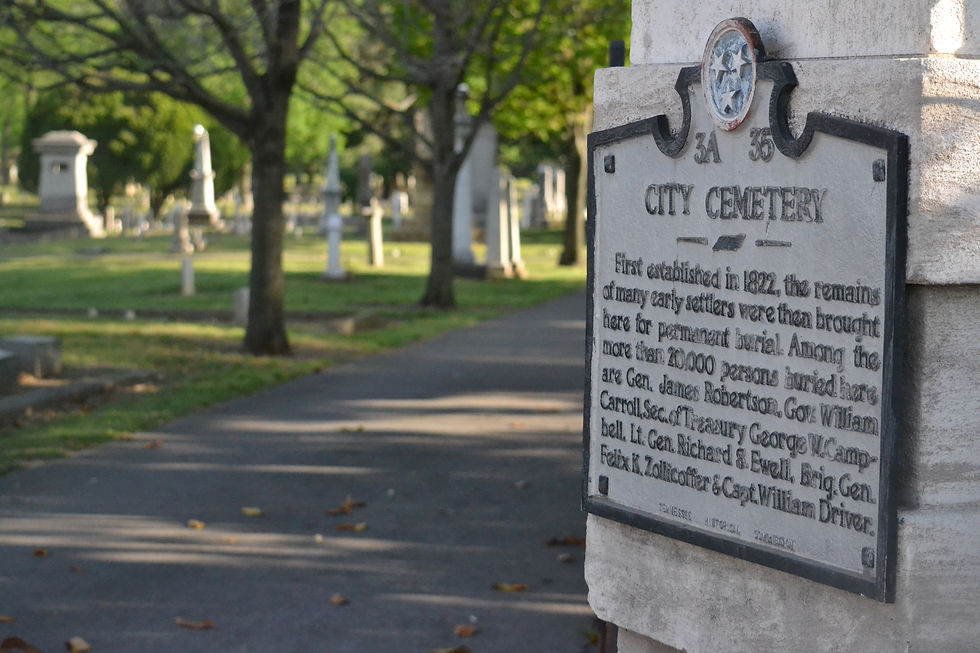
The oldest continuously operated public cemetery in Music City acts as the permanent home of some of its most notable residents; city founders James Robertson and John Cockrill, along with their wives Charlotte Reeves Robinson and Ann Robertson Cockrill, 15 different Nashville mayors and numerous generals and soldiers from the American Revolutionary War, Civil War and the War of 1812.
However, some names notably don’t don the face of large white stones despite the cemetery’s 204-year history. Thousands of people who endured enslavement are buried here as well.
“It’s a part of the South that you have to accept and know there’s aspects that we’re certainly not proud of,” said Aretha Blevins, a Nashville resident who frequents the cemetery with her two dogs, Suki and Ada.
“It’s an interesting but painful part of Southern culture.”
Despite the underlying context, Blevins—like many others—finds a peacefulness to the 22-acre space, and hopes her presence helps the dead rest in peace.
“Rather than being somber, it can be a celebration of natural history,” she said. “And I always think to myself, ‘Maybe they like that.’ I visit with my dogs, and my dogs and sniffing around and playing. I mean, maybe they were dog owners. Maybe this brings them joy that people are here and romping around and enjoying the space. If they’re floating souls, you’d think they want some company.”
Of the roughly 22,000 bodies buried in the grounds, approximately 6,000 belong to enslaved people—and an even smaller number of the enslaved people are named in the cemetery.
“Out of thousands of people, there’s like less than 20 graves that are even marked,” said Betsy Thorpe, co-president of the Nashville City Cemetery Association.

Thorpe is dedicated to rectifying that. As much as she can, at least.
The NCCA recently secured enough funding to create monuments dedicated to the unnamed slaves. It should be installed by June.
“To have a memorial where people can go and acknowledge them and leave flowers or whatever kind of memento; I think that will be meaningful,” said Thorpe, who grew up with a reverence for cemeteries. Her family made a habit of cleaning graves and leaving flowers when she was a child.
Now, on top of co-presidency, she’s an author. Her 2014 book, “The Day the Whistles Cried: The Great Cornfield Meet at Dutchman’s Curve,” details a 1918 train wreck, which killed over 100 people: one of the deadliest in American history. She chose to focus on the people involved, telling their stories opposed to the wreck itself; highlighting the impacts of various passengers and train workers on the people around them.
Her focus on people’s stories brought her here.
"I’m a history nerd, and also kind of nosy, and there’s like 22,000 stories for me to dig into at the City Cemetery. I like uncovering the stories of people that are not so known,” she said.
Even before joining the association’s board, she uncovered her favorite vignette from the cemetery: the life of Virginia Green.
Green lived in a sprawling house on 12 Avenue South. Green threw big dinner parties. Green made sure to decorate everything nicely and to invite many people.
Thorpe likes to think Green’s happy that her dinner parties still spark discussion today.
What it lacks in arc and structure, it makes up for with blunt, personable impact.
Thorpe cited an old adage as something which inspires her and the people she works with.
“Every man has two deaths, when he is buried in the ground and the last time someone says his name,” the saying—ironically with unknown origins—goes.
If there’s any veracity to the phrase, Thorpe acts as a defibrillator.
“I just think it’s nice to go out and just stand in front of a headstone and say, ‘Lucy Martin. What were you thinking?’” she said. “’What happened to you? Who were you like? What did you do? What was your favorite thing to do? What was the best day of your life? What made you cry?’”
Still, despite her best efforts, despite any memorial put up, despite any campaign, some stories will drift out of collective consciousness.
Some names and words on headstones at the Nashville City Cemetery are too worn to read. Some give descriptions and details far too vague to trace back to the person who lies beneath them.
One headstone simply reads, “Jack 1927-1940.”

And of course, some don’t even receive the luxury of a first name and a pair of years signifying the beginning and end of a human life. Some—many of whom lived lives full of immeasurable suffering—don’t even get so much as a headstone.
Still, a sort of tranquility exists between the grounds’ stone walls.
The same tranquility which brought Blevins back to walk her two dogs through its presence for over eight years.
The same tranquility which invited out-of-towners like Williams and Dougan to explore what it can offer: a strange ability to bring two grown women back to their childhood.
The same tranquility which drew Thorpe in three years ago; convincing her to take on a co-president’s role despite her initial reluctance.
The same tranquility which somehow persists despite the additions of nearby train tracks and GEODIS Park—a 30,000 seat venue hosting large concerts and sporting events.
The same tranquility which welcomed people to enjoy it for over 200 years.
Somehow, a place with over 22,000 dead people became one of Nashville’s largest celebrations of life.
“It’s a place where history is preserved in an ever-changing neighborhood,” said Thorpe. “That neighborhood just never stands still. It’s always changing. But within the stone walls of the cemetery, things are frozen in time.”

Written by Nick Rampe


Comments