


Railroad Club Chugging Along Like It's 1957

The roar of the engine echoes throughout the Tennessee countryside as a train travels
from Chattanooga to Nashville.
On its journey, the it passes under tunnels, over bridges and through small towns. The
train moves at a consistent pace in order to make it to its destination. It is crucial the train makes it in time, as it plays a key role in society.
The year is 1957; the Louisville and Nashville Railroad has just merged with the
Nashville, Chattanooga and St. Louis Railway. The railroad now connects major southeastern cities to each other through nearly 7,000 miles of track.
Nearly 70 years later, this railroad at this specific moment in time has been replicated in
Nashville, Tennessee in the basement of an inconspicuous apartment building just blocks from campus.
Located at 2101 Belmont Blvd, the exterior of the Sterling Court apartments doesn’t
seem exciting, and yet it has been hiding a very historically colorful attraction for the last three and a half decades.
The story starts in the early 90s with Brian Ehni, soon to be founding member of the train society who had just recently opened a model railroad shop in Nashville.
Soon after his arrival, an idea arose in some of his eager patrons who wanted to put their
shared love of model railroads out into the world.
But the idea wasn’t enough; the group wanted to find an area with enough space to hold
an elaborate miniature system.
Keith Summar, owner of the apartments and current member of the Dixie Model Railroad Club, came to the rescue and provided all the space needed to build a model to its fullest potential.
The club officially started in 1991 with eight members. Only two of those members
remain in today.
When entering the basement, it becomes clear that the club has made great use of the
space available. The miniature is not arranged in a simple rectangular shape, instead it twists and turns throughout the room.
Due to the abnormal shape it takes, there aren’t set dimensions, but some of the
members believe the track goes over 800 feet.
The miniature’s back edges are lined with paintings of landscapes and buildings to
signify depth. Even the pipes that adorn the wall are painted blue to blend in.
There are tracks on either side, but the journey begins on the left. After a
startup, the train turns left at the C.T. Tower where it begins its trek.
Despite the club being around for decades, the group has not finished is replica of the journey.
With the abundance of towns between Nashville and Chattanooga, it allows for a plethora
of notable locations and scenery to be replicated.
After passing the Chattanooga Brewing Co., the train passes a small town near 23rd
Avenue. This section of the miniature is decked out with gas stations, general stores and
everything else a small Tennessee town would have in 1957.
Then, the train passes by a scrapyard at Wheland before turning left at Alton Park.
To keep the geography consistent, the club has placed small signs on the side of the
model. These signs label locations, either cities or areas where identifying signals were located. These signals allowed trains to relay where they were on their journey.

With the numerous amounts of roles that come with running a miniature, the club runs like a machine with each member filling a specific role for the benefit of the miniature scale.
Founding member Tracy Reynolds finds his passion through the electronic aspects of the model.
While the sets and scenery are aesthetically beautiful to look at, when it comes to the actual running of the trains, the wiring becomes incredibly important.
“There’s a lot more to the hobby than taking the train out of the box and putting it on the
track,” said Reynolds.
Reynolds handles the polarity of the miniature, making sure the trains are travelling in the
right direction.
After Alton Park, the train travels from South to North Dixie. In between the Dixies it
passes motionless train cars carrying stone, tractors and other various items.
At North Dixie, the train takes another left where it doesn’t take long to reach North
Tunnel and a large mountain with a bridge at West End before taking another left at K.O.
While each member is passionate about individual aspects, the group is brought together
by their shared passion.
To most of the members, this is the only way they can fully act on their love of
locomotives.
“We can’t all hop on a train and be an engineer,” Reynolds said.
The model was built to replicate 1957 to make sure the landscape and buildings
throughout the model were all consistent. It removes the risk of combining decades and
awkwardly having modern skyscrapers next to 1960’s general stores.
1957 was chosen as the designated year because the year the railroads merged signified a landmark in the railroad’s history.
While the landscape is set in the past, it does not mean the trains used are required to be.
The trains each member uses are tailored to their specific interests.
Belmont student Marco Camuzzi, the youngest member of the club, uses trains modeled
from those in Great Britain and other countries.
At the left turn, the train passes Wauhatchie, and then travels next to a field in Wildwood
featuring numerous miniature animals including a zebra staring at a fox, a baby cow struggling to stand and a unicorn standing gracefully in the middle.

The train continues to wrap around before taking a large U-turn at a currently unfinished
bridge which is being worked on by Mitch Mercante, vice president of the club.
Mercante has been a part of the club for nearly 20 years. Initially Mercante was focused
on the buildings throughout the model, but after the member who handled the scenery left the club, he took over the role.
One of the biggest tools in Mercante’s arsenal is glue, which is what keeps most of the
scenery in place. This process is one that takes up most of Mercante’s time.
Reynolds jokingly has another way of describing Mercante’s role in the club.
“He spills glue,” Reynolds said.
Overhearing this from across the room, Mercante quickly responded.
“Easiest job in the whole place.”
With a wide array of roles, there is a strong focus of awareness of where everyone is and
the tasks they are focused on.
The club benefits from having members who fill specific niches; it allows them to
learn about the other aspects of model trains, sometimes in a less serious manner.
Such as when Chris Bamberg, the club’s secretary, was having trouble with
the running of a train. After trying a few options, Bamberg simply knocked on the foundation, and the train began moving again.
“I don’t think I’ve seen an approach like that before,” Mercante said, eyeing the process.
The U-turn takes the train right across from where it had been, now passing through more
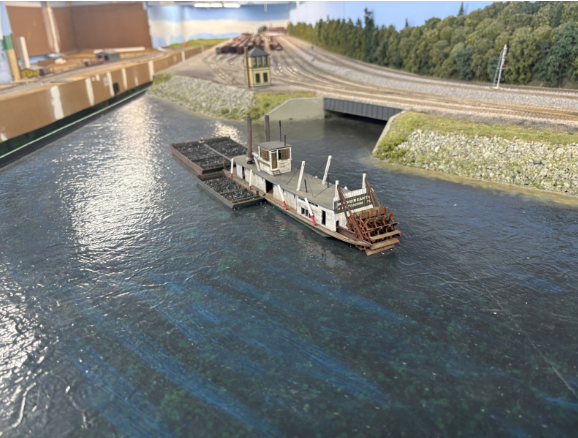
areas. The train goes through James, Shell Mound, Bridgeport, Widows Creek and Midway. In this section, it passes over two bridges where miniature people sit in canoes in the fake lake below.
It is not just the process of running the model that the men learn from, but the
miniature allows the members to gain a greater understanding of what they are passionate about.
Diving headfirst into the electronics of it all reveals a whole world of intricacies that
revolve around trains.
“We’ve learned a lot about the real,” Reynolds said.
Plus, the model being set so long ago gives the members the chance to dive headfirst into
a different time.
“It helps to be a history buff,” Reynolds said.
When the train reaches Stevenson, it hits a fork in the tracks.
If it goes left, it goes around to end up where the model started, but if it goes right, the
train will quickly pass through Sherwood and Tantallon.
The rest of its journey is through areas unfinished. At South and North Rockridge it passes by plans to build a miniature coke oven, which turns coal into a carbon fuel that is used for steelmaking.
Its ride through Tracy City, Cowan and Decherd are lined with papers detailing future plans for the expansion of the model.
As it chugs through Tullahoma, it reaches where Murfreesboro should be. But
construction for this area has yet to begin.
While there are so many meticulous sets and scenery, the model is still incomplete. But
each Saturday, the members will be in the basement slowly chipping away at whatever progress needs to be made.
Nashville may not be represented yet, but these men will make sure than when it is, it
will be historically accurate, because this is what these men love to do.
“Some of us have advanced from around the Christmas tree to around the basement,”
Reynolds said.
Written by Trey Sullivan


Run 3 is a thrilling endless runner set in outer space. Players control a small alien character running through dangerous tunnels filled with gaps and obstacles. The unique gravity mechanic allows movement on walls and ceilings, creating exciting gameplay possibilities. Each level becomes harder and tests your reflexes and timing. Unlockable characters add different abilities and playstyles, making the game more interesting. With smooth controls, creative level design, and fast-paced action, remains one of the most addictive endless runner games for players who enjoy exciting space adventures.
One of the greatest draws that keeps players hooked on speedstars for the long haul is the palpable sense of progress—whether it comes after a defeat or through shaving off a mere fraction of a second from a previous best time.